Force Times the Time of Force Application is a Summation B Continuity C Impulse D Power
Section Learning Objectives
By the end of this section, you will be able to do the following:
- Describe momentum, what can change momentum, impulse, and the impulse-momentum theorem
- Describe Newton's second law in terms of momentum
- Solve problems using the impulse-momentum theorem
Teacher Support
Teacher Support
The learning objectives in this section will help your students master the following standards:
- (6) Science concepts. The student knows that changes occur within a physical system and applies the laws of conservation of energy and momentum. The student is expected to:
- (C) calculate the mechanical energy of, power generated within, impulse applied to, and momentum of a physical system.
Section Key Terms
| change in momentum | impulse | impulse–momentum theorem | linear momentum |
Teacher Support
Teacher Support
[BL] [OL] Review inertia and Newton's laws of motion.
[AL] Start a discussion about movement and collision. Using the example of football players, point out that both the mass and the velocity of an object are important considerations in determining the impact of collisions. The direction as well as the magnitude of velocity is very important.
Momentum, Impulse, and the Impulse-Momentum Theorem
Linear momentum is the product of a system's mass and its velocity. In equation form, linear momentum p is
You can see from the equation that momentum is directly proportional to the object's mass (m) and velocity (v). Therefore, the greater an object's mass or the greater its velocity, the greater its momentum. A large, fast-moving object has greater momentum than a smaller, slower object.
Momentum is a vector and has the same direction as velocity v. Since mass is a scalar, when velocity is in a negative direction (i.e., opposite the direction of motion), the momentum will also be in a negative direction; and when velocity is in a positive direction, momentum will likewise be in a positive direction. The SI unit for momentum is kg m/s.
Momentum is so important for understanding motion that it was called the quantity of motion by physicists such as Newton. Force influences momentum, and we can rearrange Newton's second law of motion to show the relationship between force and momentum.
Recall our study of Newton's second law of motion (F net = m a). Newton actually stated his second law of motion in terms of momentum: The net external force equals the change in momentum of a system divided by the time over which it changes. The change in momentum is the difference between the final and initial values of momentum.
In equation form, this law is
where F net is the net external force, is the change in momentum, and is the change in time.
We can solve for by rearranging the equation
to be
is known as impulse and this equation is known as the impulse-momentum theorem. From the equation, we see that the impulse equals the average net external force multiplied by the time this force acts. It is equal to the change in momentum. The effect of a force on an object depends on how long it acts, as well as the strength of the force. Impulse is a useful concept because it quantifies the effect of a force. A very large force acting for a short time can have a great effect on the momentum of an object, such as the force of a racket hitting a tennis ball. A small force could cause the same change in momentum, but it would have to act for a much longer time.
Teacher Support
Teacher Support
[OL] [AL] Explain that a large, fast-moving object has greater momentum than a smaller, slower object. This quality is called momentum.
[BL] [OL] Review the equation of Newton's second law of motion. Point out the two different equations for the law.
Newton's Second Law in Terms of Momentum
When Newton's second law is expressed in terms of momentum, it can be used for solving problems where mass varies, since . In the more traditional form of the law that you are used to working with, mass is assumed to be constant. In fact, this traditional form is a special case of the law, where mass is constant. is actually derived from the equation:
For the sake of understanding the relationship between Newton's second law in its two forms, let's recreate the derivation of from
by substituting the definitions of acceleration and momentum.
The change in momentum is given by
If the mass of the system is constant, then
By substituting for , Newton's second law of motion becomes
for a constant mass.
Because
we can substitute to get the familiar equation
when the mass of the system is constant.
Teacher Support
Teacher Support
[BL] [OL] [AL] Show the two different forms of Newton's second law and how one can be derived from the other.
Tips For Success
We just showed how applies only when the mass of the system is constant. An example of when this formula would not apply would be a moving rocket that burns enough fuel to significantly change the mass of the rocket. In this case, you would need to use Newton's second law expressed in terms of momentum to account for the changing mass.
Snap Lab
Hand Movement and Impulse
In this activity you will experiment with different types of hand motions to gain an intuitive understanding of the relationship between force, time, and impulse.
- one ball
- one tub filled with water
Procedure:
- Try catching a ball while giving with the ball, pulling your hands toward your body.
- Next, try catching a ball while keeping your hands still.
- Hit water in a tub with your full palm. Your full palm represents a swimmer doing a belly flop.
- After the water has settled, hit the water again by diving your hand with your fingers first into the water. Your diving hand represents a swimmer doing a dive.
- Explain what happens in each case and why.
What are some other examples of motions that impulse affects?
-
a football player colliding with another, or a car moving at a constant velocity
-
a car moving at a constant velocity, or an object moving in the projectile motion
-
a car moving at a constant velocity, or a racket hitting a ball
-
a football player colliding with another, or a racket hitting a ball
Teacher Support
Teacher Support
[OL] [AL] Discuss the impact one feels when one falls or jumps. List the factors that affect this impact.
Links To Physics
Engineering: Saving Lives Using the Concept of Impulse
Cars during the past several decades have gotten much safer. Seat belts play a major role in automobile safety by preventing people from flying into the windshield in the event of a crash. Other safety features, such as airbags, are less visible or obvious, but are also effective at making auto crashes less deadly (see Figure 8.2). Many of these safety features make use of the concept of impulse from physics. Recall that impulse is the net force multiplied by the duration of time of the impact. This was expressed mathematically as .
Figure 8.2 Vehicles have safety features like airbags and seat belts installed.
Airbags allow the net force on the occupants in the car to act over a much longer time when there is a sudden stop. The momentum change is the same for an occupant whether an airbag is deployed or not. But the force that brings the occupant to a stop will be much less if it acts over a larger time. By rearranging the equation for impulse to solve for force you can see how increasing while stays the same will decrease F net. This is another example of an inverse relationship. Similarly, a padded dashboard increases the time over which the force of impact acts, thereby reducing the force of impact.
Cars today have many plastic components. One advantage of plastics is their lighter weight, which results in better gas mileage. Another advantage is that a car will crumple in a collision, especially in the event of a head-on collision. A longer collision time means the force on the occupants of the car will be less. Deaths during car races decreased dramatically when the rigid frames of racing cars were replaced with parts that could crumple or collapse in the event of an accident.
Grasp Check
You may have heard the advice to bend your knees when jumping. In this example, a friend dares you to jump off of a park bench onto the ground without bending your knees. You, of course, refuse. Explain to your friend why this would be a foolish thing. Show it using the impulse-momentum theorem.
- Bending your knees increases the time of the impact, thus decreasing the force.
- Bending your knees decreases the time of the impact, thus decreasing the force.
- Bending your knees increases the time of the impact, thus increasing the force.
- Bending your knees decreases the time of the impact, thus increasing the force.
Solving Problems Using the Impulse-Momentum Theorem
Teacher Support
Teacher Support
Talk about the different strategies to be used while solving problems. Make sure that students know the assumptions made in each equation regarding certain quantities being constant or some quantities being negligible.
Worked Example
Calculating Momentum: A Football Player and a Football
(a) Calculate the momentum of a 110 kg football player running at 8 m/s. (b) Compare the player's momentum with the momentum of a 0.410 kg football thrown hard at a speed of 25 m/s.
Strategy
No information is given about the direction of the football player or the football, so we can calculate only the magnitude of the momentum, p. (A symbol in italics represents magnitude.) In both parts of this example, the magnitude of momentum can be calculated directly from the definition of momentum:
Discussion
Although the ball has greater velocity, the player has a much greater mass. Therefore, the momentum of the player is about 86 times greater than the momentum of the football.
Worked Example
Calculating Force: Venus Williams' Racquet
During the 2007 French Open, Venus Williams (Figure 8.3) hit the fastest recorded serve in a premier women's match, reaching a speed of 58 m/s (209 km/h). What was the average force exerted on the 0.057 kg tennis ball by Williams' racquet? Assume that the ball's speed just after impact was 58 m/s, the horizontal velocity before impact is negligible, and that the ball remained in contact with the racquet for 5 ms (milliseconds).
Figure 8.3 Venus Williams playing in the 2013 US Open (Edwin Martinez, Flickr)
Strategy
Recall that Newton's second law stated in terms of momentum is
As noted above, when mass is constant, the change in momentum is given by
where v f is the final velocity and v i is the initial velocity. In this example, the velocity just after impact and the change in time are given, so after we solve for , we can use to find the force.
Discussion
This quantity was the average force exerted by Venus Williams' racquet on the tennis ball during its brief impact. This problem could also be solved by first finding the acceleration and then using F net = m a, but we would have had to do one more step. In this case, using momentum was a shortcut.
Practice Problems
1 .
A 5 kg bowling ball is rolled with a velocity of 10 m/s. What is its momentum?
-
0.5\,\text{kg} \cdot \text{m/s}
-
2\,\text{kg} \cdot \text{m/s}
-
15\,\text{kg} \cdot \text{m/s}
-
50\,\text{kg} \cdot \text{m/s}
2 .
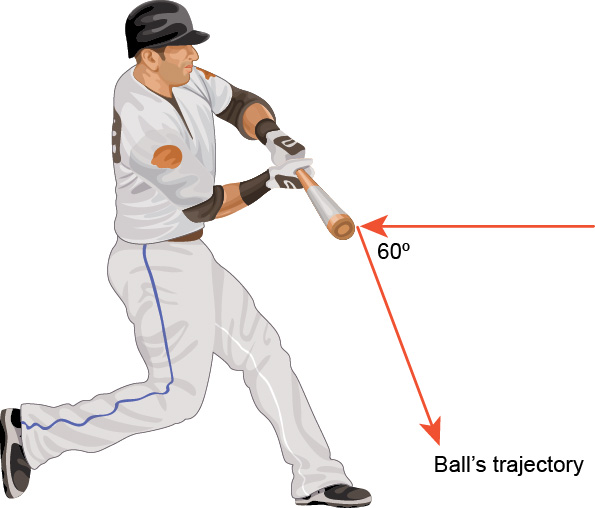
(credit: modification of work from Pinterest)
A 155-g baseball is incoming at a velocity of 25 m/s. The batter hits the ball as shown in the image. The outgoing baseball has a velocity of 20 m/s at the angle shown.
What is the magnitudde of the impulse acting on the ball during the hit?
-
2.68 kg⋅m/s.
-
5.42 kg⋅m/s.
-
6.05 kg⋅m/s.
-
8.11 kg⋅m/s.
Check Your Understanding
3 .
What is linear momentum?
- the sum of a system's mass and its velocity
- the ratio of a system's mass to its velocity
- the product of a system's mass and its velocity
- the product of a system's moment of inertia and its velocity
4 .
If an object's mass is constant, what is its momentum proportional to?
- Its velocity
- Its weight
- Its displacement
- Its moment of inertia
5 .
What is the equation for Newton's second law of motion, in terms of mass, velocity, and time, when the mass of the system is constant?
6 .
Give an example of a system whose mass is not constant.
- A spinning top
- A baseball flying through the air
- A rocket launched from Earth
- A block sliding on a frictionless inclined plane
Teacher Support
Teacher Support
Use the Check Your Understanding questions to assess whether students master the learning objectives of this section. If students are struggling with a specific objective, the assessment will help identify which objective is causing the problem and direct students to the relevant content.
Source: https://openstax.org/books/physics/pages/8-1-linear-momentum-force-and-impulse
0 Response to "Force Times the Time of Force Application is a Summation B Continuity C Impulse D Power"
Postar um comentário