What Is the Size of a Baby Alive Doll
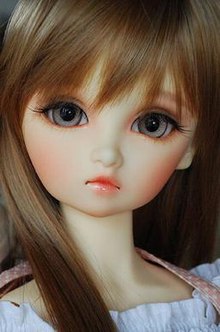
Super Dollfie, a modern Japanese ball-jointed doll (BJD) described past Time as having "exaggerated features inspired past Japanese animation".[1]
A ball-jointed doll is any doll that is articulated with ball and socket joints. In contemporary usage when referring to modern dolls, and particularly when using the acronyms BJD or ABJD, information technology usually refers to modern Asian ball-jointed dolls.[2] Many contemporary BJDs are bandage in polyurethane constructed resin, a hard, dense plastic, and the parts strung together with a thick elastic. They are predominantly produced in Japan, Republic of korea and China. There are currently no industry standards or manufacturing guidelines governing what is or is not, in fact, a BJD. There are also BJDs made by European artists, ordinarily referred to as Creative person BJDs. These dolls are normally fabricated from polyurethane resin, though can also be made out of a wide diversity of materials such equally porcelain, paper clay and super sculpey. The BJD way has been described equally both realistic and influenced by anime.
[1] [3] [four] They normally range in size from almost 60 centimetres (24 in) for the larger dolls, xl cm (15.5 in) for the mini dolls, and all the way down to 10 cm (4 in) the very smallest BJDs. BJDs are primarily intended for adult collectors and customizers. They are made to be easy to customize, by painting, changing the optics and wig, and so forth.
The modern BJD market place began with Volks line of Super Dollfie in 1999. Super Dollfie and Dollfie are registered trademarks but are sometimes erroneously used as generic coating terms to refer to all Asian BJDs regardless of manufacturer.
History [edit]
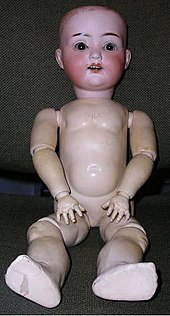
Bisque-headed German doll with ball-jointed composition body, c.1920
Articulated dolls go dorsum to at to the lowest degree 200 BCE, with articulated clay and wooden dolls of ancient Greece and Rome. The modernistic era brawl-jointed doll history began in Western Europe in the late 19th century. From the late 19th century through the early 20th century French and High german manufacturers made bisque dolls with strung bodies articulated with ball-joints made of composition: a mix of pulp, sawdust, gum and like materials.[5] These dolls could measure between xv and 100 cm (vi and 39.5 in) and are now collectible antiques.
During the 1930s the German creative person Hans Bellmer created dolls with brawl-joints and used them in photography and other surrealistic artwork. Bellmer introduced the idea of artful doll photography, which continues today with Japanese doll artists, every bit well equally BJD hobbyists.[vi]
Influenced by Bellmer and the rich Japanese doll tradition, Japanese artists began creating strung brawl-jointed fine art dolls. These are commonly made entirely of bisque and often very tall, sometimes as tall as 120 cm (47 in). These dolls are purely intended as art, and not for play or fifty-fifty the hobby level of collecting unremarkably associated with dolls. They toll several 1000 dollars, up to several hundred k dollars for older collectible dolls from famous artists. The art doll community is yet active in Nippon and artists regularly release artbooks with photographs of their dolls.[6]

The history of commercially produced Asian resin BJDs began in 1999 when the Japanese visitor Volks created the Super Dollfie line of dolls. The offset Super Dollfie were 57 cm tall, strung with elastic, ball-jointed, and made of polyurethane resin; similar to garage kits, which were Volks main product at the fourth dimension. Super Dollfie were fabricated to be highly customizable and to find a female market for Volks products.[6] [7] [eight] See further: Super Dollfie History.
The earliest Asian BJDs were influenced by the anime aesthetic.[1] [4] The early on, prominent BJD companies Volks, Cerberus Project[9] with the Delf line, likewise every bit the Japanese artist Gentaro Araki with the U-noa line,[half-dozen] all have backgrounds in anime-mode resin figure kits.
Around 2002–2003, South Korean companies started creating and producing BJDs. Customhouse[10] and Cerberus Project were amid the first Korean BJDs companies, and since then the Korean market has expanded with many more.
The earliest Chinese produced BJDs were knockoffs. Some were direct recasts, while others were slight modifications of Super Dollfie or Korean BJDs. These knockoffs were made of plaster, depression quality resin or polystone — a mix of resin and a filler fabric similar sand. They were low in price, but not very durable.[11] The first Chinese company to release their ain original BJD sculpts in high quality polyurethane resin was Dollzone. Their dolls striking the marketplace in 2006.[12] Since so, several other Chinese companies followed accommodate, putting their own BJD creations on the international market.
The first American visitor to produce a BJD with more of an American aesthetic influence was Goodreau Doll[xiii] in 2007.[fourteen]
Mod Asian BJDs [edit]
Modernistic Asian BJDs are intended for adult collectors and customizers and range in price from US$100 to over Us$1000. The more costly BJDs have body elements which are cast in polyurethane resin and held together by thick elastic cords, making them fully articulated and highly poseable. Dollfie Dreams, Smart Dolls and larger-sized Obitsu dolls are made of ABS with an outer skin fabricated of PVC. These dolls possess an internal skeleton with hinges and ball joints. The to the lowest degree expensive dolls are injection-molded ABS and have pegs connecting their joints.
BJDs tend to follow a distinctly Asian view in their aesthetics, but the designs are various and range from highly anime-inspired to hyper-realistic.[one] [3] [iv] LA Weekly said Asian BJDs are "often strangely man looking" while NPR described them as "eerily lifelike."[xv] [16] Almost are anatomically right[16] and have proportionally large heads, large eyes and comparatively large feet, contrasted with fashion dolls like Barbie, and are capable of standing on their own, without a stand or other support.
Customization [edit]
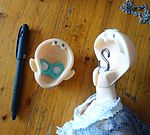
Female doll with face up removed showing replaceable optics. Note the velcro tab on the elevation of the caput for wig zipper.
BJDs are readily customizable. Wigs and eyes are easy to remove and replace, every bit well as heads, hands, and anxiety. A doll may even exist a hybrid of parts from different companies. Some BJD owners or customizers even re-shape existing parts by sanding them or applying epoxy putty to them.
The polyurethane resin material of which the college-end, hand-cast BJDs are usually made is easier to paint than the softer and more than slick vinyl oft used for other dolls, which may require a base of operations sealant to make the paint adhere properly. BJD face up paint is referred to every bit a face-up,[3] to indicate that more than than simply making up the doll's face up, all the facial features that are painted and customized. This includes the eyebrows, lips and blushing to enhance features. Face-ups and body blushing are done with watercolor pencils, acrylic paint — applied with a regular brush or an airbrush — or soft pastels, and coated with a sprayed-on layer of clear matte sealant for protection. BJD face-ups, even from big companies, are always painted by hand, and it takes considerable skill to execute detailed, professional face-ups.
Civilisation [edit]
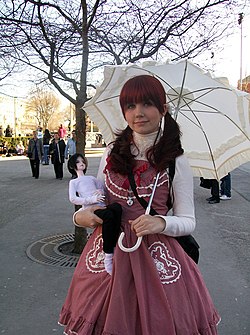
There is a sizeable international community dedicated to BJDs. The largest English language BJD internet community, Den of Angels, has over 43,000 members as of February 2016.[17] Enthusiasts also have offline BJD meetups and in the US they organize conventions, like BJDC[18] in Austin, Texas and GoGaDoll (previously Dollectable)[19] in San Francisco. In Japan, Dolls Party conventions are organized by Volks, and some enthusiasts meet and have pictures of their dolls at doll-friendly maid cafés.[twenty] In Hong Kong, a BJD convention called Dollvie [21] is organized in 2015. Canadian and Northeastern US BJD collectors nourish an annual convention called Doll North which is a part of Anime North in Toronto, Ontario.
BJDs owners ordinarily customize the await of their dolls, and they are often named, and sometimes assigned individual characteristics and personality traits. The dolls are often used every bit subjects of artistic work, such as photography[22] or drawing, which is shared on the internet. Some employ their dolls and characters for roleplaying. A small minority makes further emotional investment, going so far as to talk to their dolls equally if they were alive.[23]
Some BJDs are collectible; limited editions and skillfully customized dolls can fetch prices much higher than the original in the 2d hand market, sometimes as much equally US $5000.[24] Yet, the customization and personalization aspects are usually more emphasized in the BJD world. Fifty-fifty collectible limited-edition BJDs are played with and used as props in photoshoots, and even dolls that are no longer in mint condition can command high prices in the 2d hand market.
Many BJD owners accept other interests such as anime, Gothic Lolita and cosplay, and some dress their dolls in related styles.[25] BJDs tin can often exist seen dressed in gimmicky and coincidental youth fashions like punk or goth.[26] Other dolls may display fantasy elements like elf ears, vampire fangs, unlike types of wings, horns, hooves, and cyborg parts.
Doll manufacturers sometimes base BJDs on characters from anime, manga, other works of fiction, or fifty-fifty historical figures. Some BJD owners similarly customize their dolls to create one-off representations of existing characters or celebrities.
Asian BJDs take been featured in movies and other works. The Korean horror movie Doll Master from 2004[27] and the Taiwanese drama film Spider Lilies from 2007 feature BJDs. The virtual ring Mistula is equanimous of customized BJDs, Super Dollfie and Delf dolls. The main characters in the manga and anime Rozen Maiden are ball-jointed living dolls. The horror novel, manga and anime Another also features BJDs. BJDs are also an important motif in the movie Ghost in the Shell: Innocence where many dolls take "spirits" of some sort, but at the same time are not quite human, with designs based on the art of Hans Bellmer.[28]
Sizes and types [edit]
The earliest BJDs were all around 60 centimetres (24 in) tall, but every bit the market expanded they have been produced in many unlike types and sizes. There are roughly 3 master size categories for BJDs: total size, mini and tiny. Compare with Super Dollfie models.
Large full size dolls, sometimes referred to as SD size from the Super Dollfie size range, are effectually 60 centimetres (24 inches). Roughly 1/3 scale, they usually represent fully grown teenagers or developed body types. In that location is also a range of fifty-fifty larger full size BJD, from about seventy–90 cm (27.5–35.5 in) tall.
Mini size dolls, sometimes referred to equally MDD from Mini Dollfie Dream or MSD from the Mini Super Dollfie size range, are about twoscore cm (15.5 in) tall. At that place are two major categories of minis: those that are roughly in the same calibration every bit the 1/3 total-size dolls and meant to look like children, and mature or slim minis which are meant to represent fully grown adults that are in one/4 scale.
Tiny BJDs are under 30 cm (12 in) tall. They are available in many different types and scales.[29] Some tiny BJD are made to look similar toddlers or babies side by side to full size dolls, these are virtually 25 cm (10 in) alpine and are sometimes referred to as Yo-SD size after the Super Dollfie size range. Even smaller childlike dolls, tiny tinies, are usually not made to be in scale with any larger BJDs. A few tiny BJDs take mature bodies and are in the same 1/vi scale as fashion dolls like Barbie, about 21–30 cm (8.5–12 in) tall. Humanoid anthro animal BJDs are usually in the tiny size scale.
Production [edit]
Ball-jointed dolls are initially modeled in dirt, commonly polymer clay. The hardened clay body parts are used to class molds for multiple parts to exist cast in synthetic polyurethane resin. Cured resin has a hard, shine, porcelain-similar feel, but is less brittle. Unlike porcelain however, polyurethane tends to turn yellow and decay over fourth dimension depending on exposure to UV light and heat. The resin casting process allows for molds to be produced with a relatively low initial investment, compared to the injection molding commonly used for mass produced vinyl dolls. Even so, the materials are more expensive, and the process requires more transmission labor, resulting in a higher cost per unit.
Most regular edition BJDs come assembled with an option for a "face-upward," the facial blushing and painting, while total set BJDs, which are oft limited, include clothes, face-upwards, and sometimes full body blushing. A few BJDs are sold as blank unassembled parts in a kit, like to a garage kit.
Lines and companies [edit]
BJDs are produced by annihilation from single-person outfits on a hobby level, to incorporated multinationals. Hobby artists in Asia, particularly Japan, and the West, particularly The states and Australia, create and sell their ain dolls. In Asia at that place is a wide diversity of companies making BJDs, about based in Republic of korea. The BJD Orbyrarium book lists 49 different BJD companies[30] and one fan-run BJD database includes 125 companies as of February 2009.[31] As of March 2018, there are over 600 unlike BJD companies and contained artists worldwide.[32] A few of the nearly notable BJD lines and companies tin can be found below.
On occasion, unauthorized copies or recasts of original dolls are sold, predominantly in S-East Asia. Several Korean and Japanese BJD companies have posted notices warning confronting recast dolls.[33] [34] [35] [36] There is a stiff resistance against these knockoff dolls inside the BJD community. They are for case not allowed to be posted on the largest English BJD forum.[37]
Nippon [edit]
- Super Dollfie from Volks
Super Dollfie[24] [30] from Volks was the starting time line of modern Asian BJD. They fix the range of sizes used past near companies. Volks have released a vast variety of different dolls, most of them express editions, some in collaboration with fashion designers like Baby, The Stars Shine Bright and H. Naoto or anime series like Rozen Maiden. Volks has a number of stores in Japan and Korea, as well equally ane in Los Angeles.[38] They also run the Super Dollfie museum, Tenshi-no-Sato in Kyoto, Nippon. In 2004, Time mag described Super Dollfie equally having "trendily refined makeup" and "exaggerated features inspired by Japanese animation".[1] Shojo Beat, in 2008, said they have "cool glassy expressions", "a distinct anime look" and that their styles "stay true to a Japanese aesthetic."[4]
- U-noa
The Japanese artist Gentaro Araki first started in BJDs in 2000 with the sixty cm Andolrea U-Noss line in collaboration with Volks.[6] [39] He later went on to create his own company called Alchemic Labo with a line of mature minis called the U-noa Quluts,[6] [24] [30] and after continued to branch out to other sizes including the 35 cm Unoa Quluts Chibi [twoscore] and the 64 cm Unoa Zilch/Unon.
Korea [edit]
- Delf from Luts and Cerberus Project
The Delf[24] [30] dolls were one of the earliest lines from Korea, dating dorsum to 2003. They are slightly taller and slimmer than Super Dollfie and there is a variety of doll types available, including dolls with elf ears and vampire teeth. Delf were originally designed by Japanese resin kit designers Cerberus Project[9] and fabricated and distributed past the Korean company Luts,[41] who also own the rights to utilise the Delf name. These dolls are often referred to by the acronym CP, or every bit Luts dolls, subsequently the benefactor; dolls produced afterwards 2007 are correctly known but as Luts dolls due to a divide betwixt Cerberus Projection and Luts, who at present merchandise separately. Minifee are mini-sized versions of the Delf dolls, distributed by Korean company Fairyland.[42]
- Custom Firm
Custom Firm[30] [43] is 1 of the oldest Korean BJD companies. Their dolls were featured in the Korean horror moving-picture show Doll Master from 2004.[27]
- Doll in Mind
D.I.G (Doll in Mind)[24] produced, among other dolls, the Minimee, completely customized heads created from customer photos or drawings.[44] Some people commissioned heads from them in the likeness of celebrities, anime/video game characters, TV show personas, or even comic volume characters.
- Dollshe
Dollshe[xxx] [45] introduced a line of alpine, slim, double jointed mature boy dolls in 2003. These are slightly larger full size BJD, about 68 cm tall. Their Bermann doll was strictly limited and is i of the most sought later collectible BJDs. Tensiya has since dissever with Dollshe.
- Dream of Doll
D.O.D. (Dream of Doll)[30] [46] was one of the earliest Korean companies to make a large line of child similar minis, D.O.C. (Dream of Children). They accept since expanded and now make, among others, the D.O.T. (Dream of Teen) line, the D.O.B line (Dream of Babe), and D.O.I. (Dream of Idol) line.
- Elfdoll
Elfdoll[24] [30] [47] is a subsidiary of the Korean visitor Artmaze. Elfdoll are created by the sculptor Rainman and a team of artisans. In addition to a range of fullsize human dolls, Elfdoll have released many types of tiny anthro BJDs, start with Catsy. They had a exhibit in Glendale, California, opened in August 2007 where they held parties and meetups for BJD enthusiasts. In 2007, LA Weekly described Elfdoll dolls as having "detailed, human-like features."[3]
Red china [edit]
- Dollzone
Dollzone[48] [49] was one of the first Chinese BJD doll brands, developed and manufactured past Shenzhen Ruddy Gild Toys Ltd. Dollzone make male and female person dolls, 1/iii and i/4 dolls, and BB dolls in 26 cm size.
- Angell Studio
Angell Studio was established in HangZhou, Prc in 2005 as one of the earliest BJD creators in Communist china. In 2013, the company collaborated with makers of Gujian Qitan (古剑奇谭), a pop Chinese MMOG to create ball jointed dolls for the game.[50]
Doll Leaves
Doll Leaves is a Hong Kong based ball jointed doll company introduced in April, 2010. The company produces both male and female dolls in sizes ranging from 12 cm to seventy cm in a variety of skin tones.[51]
Brawl-jointed style dolls [edit]
Resin ball-jointed style dolls like the Sybarite and JAMIEshow Dolls differ from the typical Asian BJD in several ways. Their master influence is from the collectible American sixteen inch vinyl fashion dolls, like Gene Marshall past Ashton-Drake Galleries and now fabricated in resin past JAMIEshow Dolls and Tyler Wentworth past Tonner. Ball-jointed fashion dolls are commonly around sixteen inches tall, closer to i/4 scale than the typical 1/iii calibration of Asian BJDs. They have more lifelike proportions, smaller heads and eyes, and less artless, more distinctive facial features
Vinyl dolls [edit]
There are several types of larger 60 cm vinyl dolls in Japan. They are in the aforementioned scale as fullsize BJDs, with similar proportions. The two nearly mutual types are Dollfie Dream from Volks and Obitsu. The kickoff Dollfie Dream body type was strung and had archetype ball and socket joints, but the electric current body has an internal skeleton of difficult plastic,[52] [53] as do the Obitsu dolls. The vinyl bodies tin can, sometimes with some modifications, be combined with a resin BJD head.
Vinyl dolls usually take facial features that are more than highly stylized later anime and less realistic than the typical resin BJDs. Vinyl dolls are easier to manufacture, machine-made and injection-molded in soft vinyl, and thus lighter and frequently less expensive than their Japanese resin counterparts, with the exception of their circuitous skeleton structure which tin often justify a higher price. Injection-molded manufacture requires more intensive set-up costs and a higher number of each doll is produced compared to resin dolls, despite this Japanese companies similar Volks and Obitsu often accept big stock shortages of their vinyl dolls or doll parts.
- Smart Doll by Danny Choo
Smart Doll is a range of ane/3 scale, vinyl fashion dolls by Danny Choo. British-built-in Choo, the son of fashion designer Jimmy Choo, is a Malaysian blogger, idiot box personality and the creator of Culture Nihon, a Japanese television show that celebrates and explores Japanese culture. His outset doll, Mirai Suenaga, became the mascot for Japanese Tourism in 2014.[54] Smart Doll is available in 4 skin types: Cocoa, Tan, Cinnamon and Milk and feature interchangeable busts, easily, anxiety (for apartment-soled and high-heeled shoes) optics and wigs of various colors and lengths, all of which are manufactured exclusively in Nippon. Smart Doll too has two dolls with port-wine stain facial birthmarks and one doll with Vitiligo. Smart Doll's blueprint and business philosophy centers around wabi-sabi, a set of Japanese design principles that gloat imperfection and asymmetry. Their intricately designed and weathered vesture showcase this pattern characteristic. In 2019, Smart Doll released an additional body type made of a harder substance called Cortex,[55] which is sturdier, resists staining from dark-colored apparel and is less-expensive than vinyl. While the original Smart Doll's faces are created in the Japanese Anime/Manga aesthetic, the company is in the process of releasing additional dolls referred to every bit "Semi-Existent" which resemble more lifelike characters from video and computer games. Additionally, Smart Doll has partnered with Warner Bros. Consumer Products to create a line of DC Comics heroes and heroines which will as well exist created in the Japanese Anime/Manga aesthetic.
See too [edit]
- Asian style doll
- Super Dollfie
References [edit]
- ^ a b c d e Holton, Avery (July 18, 2004). "Anime Girls". Time. Archived from the original on 11 December 2008. Retrieved Dec 26, 2008.
Japanese-made Super Dollfies ... with ... exaggerated features inspired past Japanese animation
- ^ "Tips on Collecting Dolls for Beginners and Avant-garde Collectors". Retrieved 26 May 2017.
- ^ a b c d Ohanesian, Liz (October 28, 2008). "Elfdoll: Don't Phone call It A Toy Visitor". LA Weekly. Archived from the original on 2011-03-20. Retrieved December 26, 2008.
The shockingly realistic, remarkably flexible BJDs
- ^ a b c d Gonzalez, Lauren (June 2008). "The Futurity Looks Bright for Brawl-jointed Dolls". Shojo Trounce. p. 332.
Super Dollfie, like Narin and Narae, accept a distinct anime await, with cool burnished expressions on their faces. Although highly customizable, the dolls are offered in a range of styles that stay true to a Japanese aesthetic.
- ^ "Glossary of Doll Collecting Terms -- Composition". Archived from the original on 16 December 2008. Retrieved 26 May 2017.
- ^ a b c d e f Japattack - Effigy+Doll=U-noa (Unoa Doll) Archived May 27, 2008, at the Wayback Car
- ^ 1998 | SD 10 Twelvemonth History of Super Dollfie | Super Dollfie 10th Anniversary Special Web Site | VOLKS INC (Archived July 26, 2011, at the Wayback Automobile 2011-07-29)
- ^ 1999 | SD x Year History of Super Dollfie | Super Dollfie 10th Ceremony Special Spider web Site | VOLKS INC (Archived July 26, 2011, at the Wayback Motorcar 2011-07-29)
- ^ a b "Cerberusproject". www.cerberusproject.com . Retrieved 26 May 2017.
- ^ Custom House official site - company history Archived December 16, 2008, at the Wayback Car "2002 December : Ball Jointed Doll company started." (https://web.archive.org/web/20090614234648/http://www.customhouse.co.kr/en/about/index.asp)
- ^ Super Dollfie FAQ - Yumia (Forever)
- ^ "Dollzone returns?". Retrieved 26 May 2017.
- ^ "Goodreau Doll Official Site". Archived from the original on 4 March 2016. Retrieved 26 May 2017.
- ^ "Tips on Collecting Dolls for Beginners and Advanced Collectors". Retrieved 26 May 2017.
- ^ Pacific Media Expo Introduces Asian Ball-Jointed Doll Programming to the Convention - La Weekly, Nov 14, 2011
- ^ a b Invasion Of The Ball-Jointed Dolls - NPR, September 09, 2008
- ^ "Featured Threads". Den of Angels . Retrieved 26 May 2017.
- ^ "BJDC 2017". bjdctexas.com . Retrieved 26 May 2017.
- ^ "Invasion Of The Brawl-Jointed Dolls". Retrieved 26 May 2017.
- ^ Galbraith, Patrick West. "Plastic fantastic: Nihon's doll industry booming". Urban center magazine. Archived from the original on 2011-06-05. Retrieved 2009-02-22 .
Dragon is friends with many other users, but prefers to go along his avocation a hush-hush and and then only meets them at St Grace's Court, a doll user-friendly costume café outside Akihabara, and dolpas, or doll parties where fans tin assemble ... the possessor allows them to organize exchange parties and accept pictures of their dolls. There is even a "doll set" (700 yen) of miniature tea and sweets on the carte du jour for users to society for utilize in posing their dolls or offering them refreshments.
- ^ "Dollvie Hong Kong Official Website". www.dollvie.com . Retrieved 26 May 2017.
- ^ Galbraith, Patrick W. "Plastic fantastic: Japan's doll industry booming". Metropolis magazine. Archived from the original on 2011-06-05. Retrieved 2009-02-22 .
...the inclusion of brawl joints, which make information technology possible to pose the dolls for pictures, a favorite pastime among users.
- ^ Galbraith, Patrick Due west. "Plastic fantastic: Nippon's doll industry booming". Metropolis magazine. Archived from the original on 2011-06-05. Retrieved 2009-02-22 .
...the minority "wet users," or those who make an emotional investment in their dolls, sometimes even publicly carrying, caressing and talking with them ... [some] attend doll "commutation parties" to talk and play with dolls amid invited guests ... "People tin can't hear my friends [dolls] because they don't believe," says Mai, a 23-year-old college pupil from Hiroshima who has been talking to dolls since she was a child. "You can't approach them similar objects."
- ^ a b c d e f Gonzalez, Lauren (June 2008). "The Future Looks Bright for Ball-jointed Dolls". Shojo Trounce.
- ^ Gonzalez, Lauren (June 2008). "The Future Looks Vivid for Ball-jointed Dolls". Shojo Vanquish. p. 330,332.
Den founder Aimee Steinberg believes in that location is a surge in this BJD'southward [sic] popularity due to conventions and mag coverage. Fans of anime, Gothic Lolita [and] cosplayers are discovering these BJDs," she says. Cosplayers and Gothic Lolita fans, Steinberg explains, 'enjoy dressing their dolls and sometimes themselves in matching outfits.'
- ^ Ohanesian, Liz (October 28, 2008). "Elfdoll: Don't Call It A Toy Company". LA Weekly. Archived from the original on sixteen December 2008. Retrieved December 26, 2008.
At the showroom'south Oct 25 party, hobbyists arrived with arms filled with pieces from their ain collections reconfigured to fit Halloween images of comic volume heroes, steampunks, fairies, Japanese-styled Lolitas and goth boys in drag.
- ^ a b Custom House official site - company history Archived December 16, 2008, at the Wayback Auto "2004 July : Movie [Doll Chief] Main character Mina doll released"
- ^ Monnet, Livia, 'Beefcake of Permutational Desire: Perversion in Hans Bellmer and Oshii Mamoru',Mechademia 5 (2010), 285-309
- ^ Google Docs - Tiny BJD Sizes reference sheet
- ^ a b c d e f g h Aimee Steinberger, Mia Peterson, ed. (2006). BJD Orbyrarium. Murat Caviale Inc.
- ^ "gigglegeek.dk". world wide web.gigglegeek.dk. Archived from the original on 28 March 2016. Retrieved 26 May 2017.
- ^ "Dollmakers - Den of Angels BJD Wiki - Den of Angels". denofangels.com . Retrieved 28 May 2018.
- ^ Important Notice: Beware of imitation/VOLKS INC Archived 2009-06-25 at the Wayback Motorcar June 28, 2006
- ^ Beware fake dolls!! LUTS [ permanent expressionless link ] 2008-11-21
- ^ A significant attending regarding the Copied/Pirate BJDS! - SOOM 2009/03/13
- ^ Illegal copy of Iplehouse dolls 2009/03/13
- ^ "Banned dolls - Den of Angels BJD Wiki - Den of Angels". denofangels.com . Retrieved 26 May 2017.
- ^ "Volks USA Inc". Archived from the original on 3 Apr 2015. Retrieved 26 May 2017.
- ^ "Where Angels Lie - A Super Dollfie Database - Others". www.angelden.net . Retrieved 26 May 2017.
- ^ "Unoa Quluts Chibi - Den of Angels BJD Wiki - Den of Angels". denofangels.com . Retrieved 26 May 2017.
- ^ "Luts". Retrieved 26 May 2017.
- ^ "FairyLand". Retrieved 26 May 2017.
- ^ "aiNai.com". Retrieved 26 May 2017.
- ^ www.dimdoll.com. "D.I.One thousand - Doll in Mind ball jointed doll". world wide web.dimdoll.com . Retrieved 26 May 2017.
- ^ "Tensiya.com". tensiya.com . Retrieved 26 May 2017.
- ^ "Dream Of Doll". Archived from the original on 20 Nov 2016. Retrieved 26 May 2017.
- ^ "elfdoll.com - elfdoll Resources and Information". www.elfdoll.com. Archived from the original on 3 September 2019. Retrieved 26 May 2017.
- ^ Tú vales mucho, muñeca - El País 07/06/2008
- ^ "www.dzdoll.com". www.doll-zone.com . Retrieved 26 May 2017.
- ^ liyichun_gz, lifen_csj_gz. "跨界合作 《古剑奇谭》BJD娃娃全新亮相_单机游戏资讯_太平洋游戏网". pc.pcgames.com.cn . Retrieved 26 May 2017.
- ^ "~Doll Leaves~". bjdcollectasy.com . Retrieved 2017-02-01 .
- ^ "Volks - DD Bones Trunk/Dollfie Dream". Archived from the original on 23 October 2010. Retrieved 26 May 2017.
- ^ "Volks - DD Base of operations Body2/Dollfie Dream". Archived from the original on 24 October 2010. Retrieved 26 May 2017.
- ^ "| TokyoTreat: Japanese Candy & Snacks Subscription Box". TokyoTreat. 2016-08-x. Retrieved 2019-12-nineteen .
- ^ "Cortex or Vinyl?". Smart Doll . Retrieved 2019-12-19 .
External links [edit]
- Den of Angels the largest English BJD community
- TheBJDPlace Beginner's Guide,FAQ & BJD Artist/Shop Directory 2019
Source: https://en.wikipedia.org/wiki/Ball-jointed_doll
0 Response to "What Is the Size of a Baby Alive Doll"
Postar um comentário